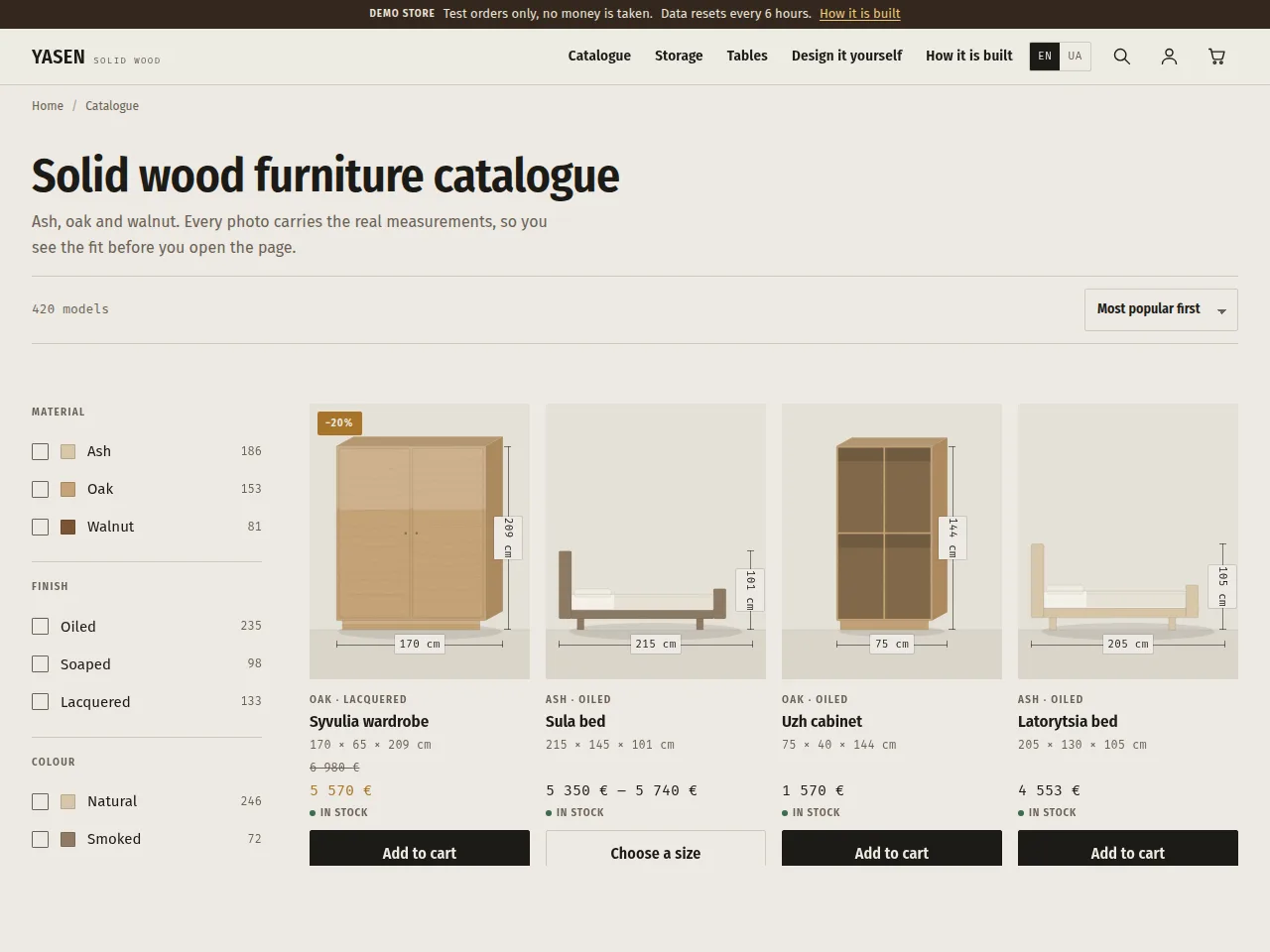
WooCommerce
measuredWordPress + WooCommerce
Full shop: cart, two-step checkout, delivery zones, promo codes, a live order notification to Telegram.
Open the standCase 04 · devs-code.site
The same 420-item catalogue, the same layout, four different engines. All four stands are live — open them side by side. The speed numbers below are measured every night on our server, not typed in by hand.
No platform is “ours”. We build on all four and get paid the same. That is why this table is worth reading.
WordPress + WooCommerce
Full shop: cart, two-step checkout, delivery zones, promo codes, a live order notification to Telegram.
Open the stand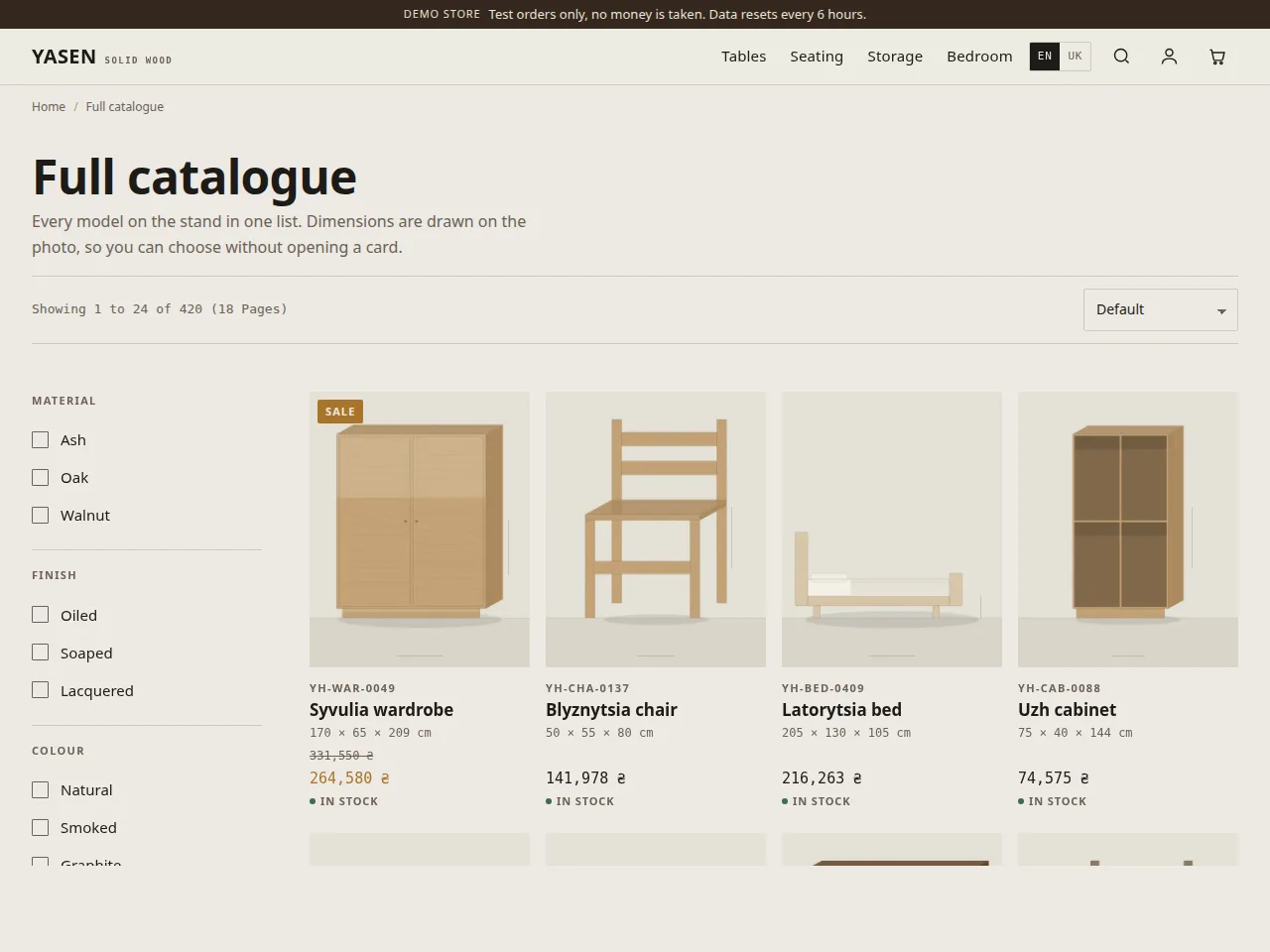
OpenCart 4
The same shop on OpenCart 4: catalogue, cart, checkout, Ukrainian UI.
Open the stand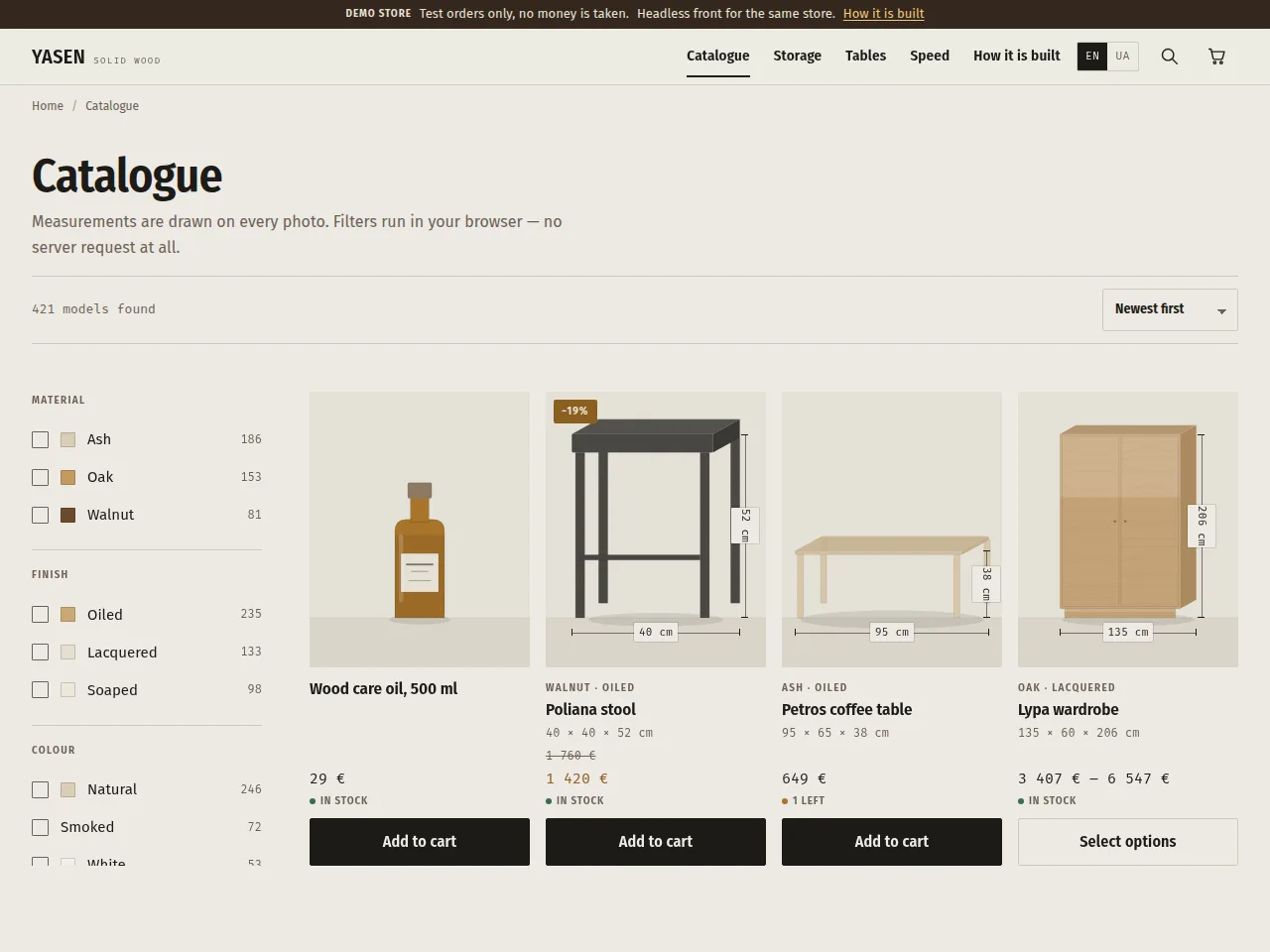
Astro + WordPress REST
Static front on Astro pulling the same catalogue from the WordPress REST API.
Open the stand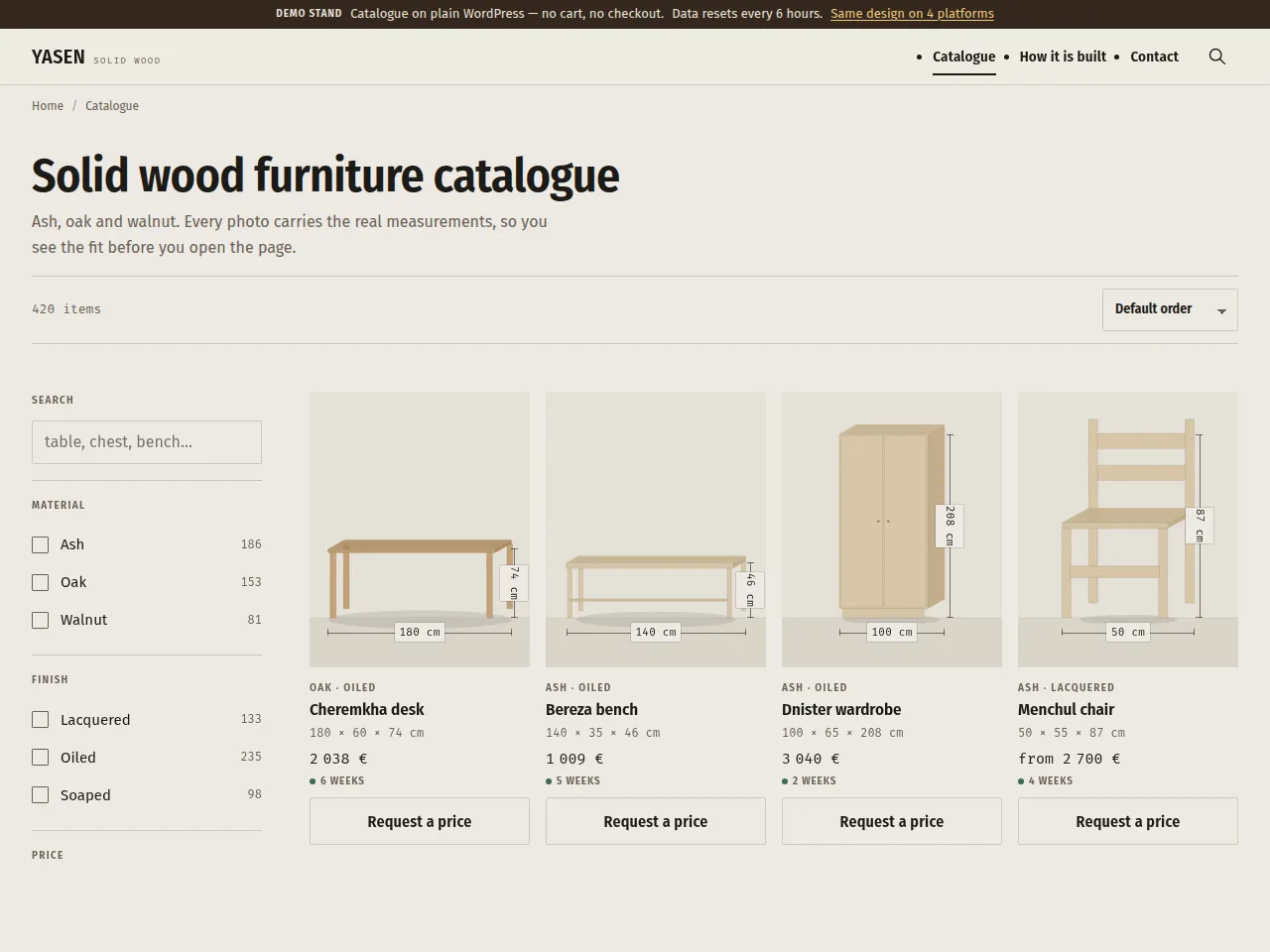
WordPress, no shop plugin
The same catalogue with filters and search, and a price request instead of a cart.
Open the standLighthouse, mobile preset, three runs, median. Re-measured every night. The date under each column is when these exact numbers were taken.
Swipe the table sideways to see all four →
| WooCommercemeasured 4 Sept 2026 | OpenCartmeasured 4 Sept 2026 | Headlessmeasured 4 Sept 2026 | WordPress cataloguemeasured 4 Sept 2026 | |
|---|---|---|---|---|
| Performance scoreLighthouse performance, 0–100. Anything above 90 is good on mobile. | 100 | 99 | 100 | 100 |
| LCPWhen the main image or headline finishes drawing. Google wants under 2.5 s. | 1.35 s | 1.69 s | 1.35 s | 1.32 s |
| CLSHow much the layout jumps while loading. Google wants under 0.1. | 0.000 | 0.001 | 0.000 | 0.000 |
| Server responseHow long the server thinks before the first byte. | 2 ms | 107 ms | 1 ms | 2 ms |
| Page weightEverything the browser downloads for one page. | 115 KB | 164 KB | 93 KB | 96 KB |
| RequestsHow many files that page pulls. | 15 | 23 | 18 | 14 |
| JavaScript shippedScript bytes — the part that keeps a phone busy after the pixels are there. | 13 KB | 5 KB | 7 KB | 3 KB |
This part is not measurable, so it is marked as an estimate: our prices and our experience with projects of this size. Numbers here are for a commercial build, not for a demo stand.
Swipe the table sideways to see all four →
| WooCommerce | OpenCart | Headless | WordPress catalogue | |
|---|---|---|---|---|
| Who it is for | Online sales with payment, stock and delivery from day one. | You already have an OpenCart shop, or your team knows this admin. | Large catalogues where speed and search traffic are the business. | Made-to-order work, showrooms, B2B ranges — where the deal happens in conversation. |
| Limits | The heaviest of the four. Plugins need updating, and every plugin is a dependency you inherit. | A shrinking ecosystem. Fewer maintained extensions each year, and paid ones age fast. | Two systems instead of one. Content changes need a rebuild, and someone has to own that pipeline. | No cart, no checkout, no stock. A second language costs a plugin and about a day. |
| Build time | 4–6 weeks | 3–5 weeks | 5–7 weeks | 1–2 weeks |
| Running cost | €40–80 / month | €30–60 / month | €25–50 / month | €15–30 / month |
A comparison you cannot check is an opinion. Here is exactly what happens every night.
Do not take our word for it: paste any of the four addresses into pagespeed.web.dev and compare. Field data there will be empty — nobody browses demo stands — but the lab numbers should land where this table says.
Five situations we actually hear from clients, and what we would build in each.
I sell 50–500 products and take card payments online.
WooCommerce.
Cart, checkout, stock, taxes, delivery and invoices already exist and are maintained by other people. Writing that yourself costs more than the plugin licences ever will.
I already run an OpenCart shop and I am told to throw it away.
Keep it — until it actually blocks you.
A working shop with orders in it is an asset. We can redesign it, speed it up and add integrations. Migration makes sense when the platform blocks a specific business need, not because a developer prefers another engine.
My catalogue is large and organic traffic is the business.
Headless: static front, CMS behind it.
Pages are pre-built, so the server does not think at all. The price is a second moving part: the front has to rebuild when content changes, and someone has to own that.
We make to order. The deal happens in a chat or a phone call.
A catalogue site on plain WordPress.
A cart nobody uses is a cost, not a feature. Show the range, take the enquiry, sell in the conversation — for three to five times less money.
I need to be online in a week and see if anyone wants this at all.
Catalogue site first, shop later.
The catalogue build becomes the shop’s foundation: same design, same content, same admin. You pay for the shop layer when demand is proven, not before.
Send us the range you sell and how the deal usually closes. We answer with a platform and a reason — including “stay where you are”, when that is the honest answer.
Write to us